Patron saints
Our Lady, Undoer of Knots
Mother of God, who crushes the serpent’s head
The knot of Eve, untied by Mary
The title “Undoer of Knots” grows out of one of the oldest ways the Church has spoken about the Blessed Virgin Mary. In the second century, St. Irenaeus of Lyons compared Mary with Eve: what Eve bound through disobedience, Mary loosened through her faith and obedience to God.1 The Second Vatican Council took up the same image, teaching that “the knot of Eve’s disobedience was untied by Mary’s obedience.”2
“What the virgin Eve bound by her unbelief, the Virgin Mary loosened by her faith.”13
Mary’s “yes” at the Annunciation did not solve humanity’s problems by her own power. It opened the door to her Son, Jesus Christ, who alone saves us. That is why devotion to Mary always leads to Christ: she is the Mother who brings her children to God.
The woman who crushes the serpent’s head
After the fall in Eden, God promised that enmity would exist between the serpent and the woman, and between their offspring, and that the serpent’s head would be struck.4 The Church has long seen in this promise the first announcement of the Redeemer and of His Mother. The Book of Revelation also describes “a woman clothed with the sun, with the moon under her feet, and on her head a crown of twelve stars,” who stands against the dragon.5
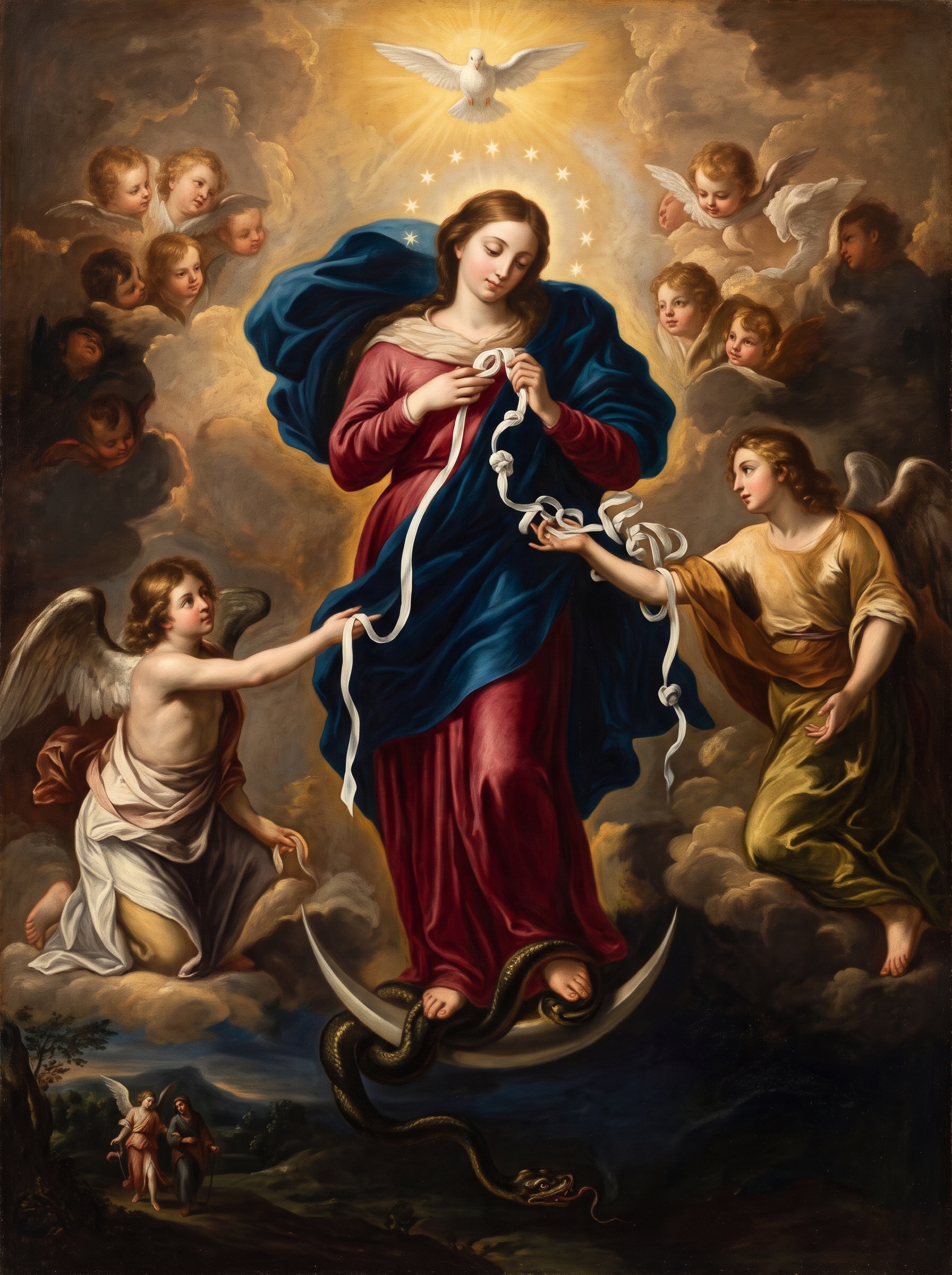
Both images are woven into the well-known painting of Our Lady, Undoer of Knots. Mary stands on the crescent moon, crowned with stars, with the Holy Spirit above her as a dove. Angels hand her a long ribbon tangled with knots, which she patiently unties and passes back smooth. Beneath her foot lies the serpent, itself twisted into a knot—a reminder that the enemy’s work is undone by God’s grace.
A painting from Augsburg
The original image was painted around 1700 by Johann Georg Melchior Schmidtner and hangs in the church of St. Peter am Perlach in Augsburg, Germany. A popular story connects it to a struggling married couple in the early 1600s who sought help from a Jesuit priest, Fr. Jakob Rem, and were reconciled after he prayed before an image of Mary. Historians have not been able to confirm that story, but the painting has drawn pilgrims for generations.6
The devotion became widely known through Jorge Mario Bergoglio, later Pope Francis, who helped spread it in Buenos Aires, Argentina. After his election in 2013, it spread around the world.6
Bringing our knots to Mary
In a Marian address in October 2013, Pope Francis described how sin and unresolved problems can form “a kind of knot” deep within us, taking away our peace and serenity. He invited each person to ask, “What are the knots in my life?” and assured them that “all the knots of our heart, every knot of our conscience, can be undone” through God’s mercy.3
Many people bring particular knots to Mary in prayer: a strained marriage, a broken relationship in the family, an addiction, a financial burden, a hardened heart, or a sin they cannot seem to overcome. Asking for her intercession is a way of placing those knots, one at a time, into the hands of the Mother who leads us to her Son.
A note about this devotion
Our Lady, Undoer of Knots is not a separate Mary or a formula that guarantees a particular outcome. She is the same Blessed Virgin Mary, Mother of God, honored under a title that expresses her faith and her role in leading us to Christ. Mary does not replace her Son; she points to Him, as she did at Cana: “Do whatever he tells you.”
Bringing our knots to Mary is an invitation to prayer, conversion, and patience. Some knots are loosened quickly; others take time, the sacraments, honest effort, and the help of others. Through it all, we can trust that God’s grace is stronger than any knot.
Sources
- St. Irenaeus of Lyons, Against Heresies, Book III, ch. 22, no. 4. Read at New Advent
- Second Vatican Council, Lumen Gentium, 56. Read at Vatican.va
- Pope Francis, Marian Prayer for the Marian Day, October 12, 2013. Read at Vatican.va
- Genesis 3:15 (NABRE). Read at USCCB.org
- Revelation 12:1 (NABRE). Read at USCCB.org
- “Mary, Untier of Knots,” history of the Augsburg painting and devotion. Read at Wikipedia
Questions? info@catholicsrejectsatan.org